
Why Imaginative Play Matters — and What We Lose When Children Stop
- Gary Wizart

- Mar 20
- 2 min read
Updated: Apr 12
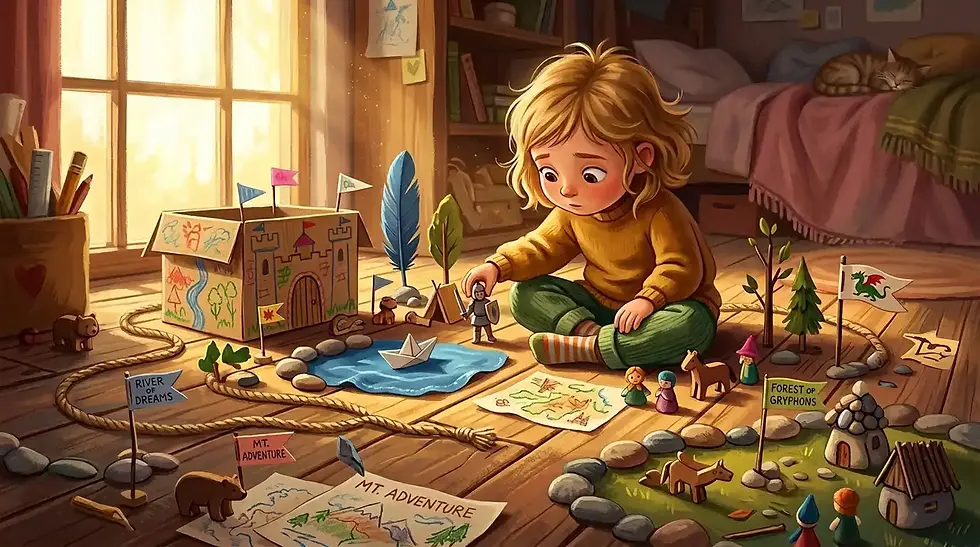
There was a time when you built worlds before breakfast.
A blanket over two chairs became a cave, a kingdom, a spaceship depending on the hour. The garden was a jungle. The staircase was a cliff. A cardboard box was never just a cardboard box. You moved through ordinary rooms the way explorers move through unmapped territory — with total conviction that what you saw was real, and that what happened next mattered enormously.
Nobody taught you how to do this. You simply did it.
We tend to look back on this kind of play with a fond, slightly wistful distance — as though it were a charming feature of childhood that we eventually and rightly grew out of, like training wheels or afternoon naps.
But researchers who study what is actually happening inside a child at play have found something that should give any creative person pause.
When a child builds an imaginary world, they are not escaping reality. They are practising one of the most cognitively demanding things a human mind can do. Perspective-taking. Narrative construction. Holding multiple possibilities open at once. Making meaning from nothing but the raw material of the present moment.
In other words — they are doing exactly what writers, illustrators, filmmakers, and
storytellers of every kind spend their whole careers trying to do.
The child sprawled on the floor with a handful of plastic animals and an afternoon to fill is not playing at being a storyteller.
They already are one.
What changes, as we grow, is not the capacity. It's the permission.
Somewhere along the way, most of us absorbed the idea that imaginative play was a phase — something to be gently set aside in favour of more serious pursuits. That making things up was fine for children but vaguely embarrassing in adults. That the worlds inside our heads needed a practical justification before they were worth visiting.
And so we stopped dropping everything to follow a strange and luminous idea wherever it wanted to go.
The most alive creative work — the stories that stay with us, the images we can't quite forget, the songs that arrive like memories of places we've never been — tends to carry something of that original quality. A sense of total conviction. Of meaning that doesn't wait to be explained. Of a world built from the inside out, because the builder couldn't imagine not building it.
It isn't childish. It's the thing that was always there, waiting patiently beneath the more sensible versions of ourselves we learned to become.
The invitation isn't to be a child again. It's something quieter than that.
It's to remember that the part of you that once turned a cardboard box into a kingdom hasn't gone anywhere. It has simply been waiting for you to come back and play.
What did you used to make, before you knew it was supposed to be difficult?
Further reading: The research on imaginative play and what it reveals about creative development is more surprising than you might expect. This piece from Harvard is a warm and illuminating place to begin.


Comments